Introduction
I wanted to start visual astronomy from the Bay Area and needed to pick a first telescope. I spent three months learning the sky with just my eyes and a star chart app before buying any optics.
Dark adaptation takes 20-30 minutes of no screen exposure. Once your eyes adjust, the number of visible stars increases noticeably, even from a Bortle 6-7 site like Foster City. The constellations became familiar first: Orion in winter, Scorpius in summer, the Big Dipper year-round. Then the brighter deep-sky objects: the Orion Nebula as a fuzzy patch below the belt, the Pleiades as a tight cluster, the Andromeda Galaxy as a smudge near Cassiopeia.
This phase taught me what I actually wanted from a telescope. Not astrophotography — that is a different hobby with different equipment. Visual observation: looking through an eyepiece and seeing the object directly.
Design Considerations
Three main designs exist for amateur visual astronomy:
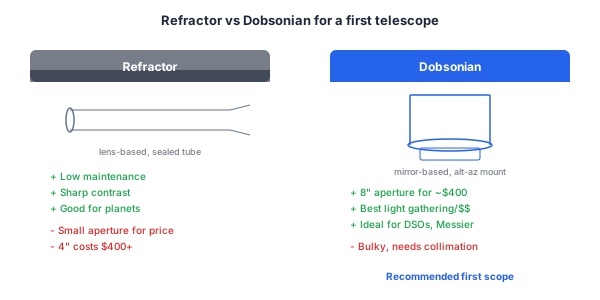
Refractors use a lens at the front of a sealed tube. They produce sharp, high-contrast images and require no maintenance. The problem is cost per aperture. A 4-inch refractor costs $400-600 and aperture is everything for deep-sky objects.
Newtonian reflectors use a concave mirror at the bottom of an open tube. They deliver far more aperture per dollar than refractors. An 8-inch Newtonian mirror collects four times as much light as a 4-inch refractor lens.
Dobsonian telescopes are Newtonian reflectors on a simple alt-azimuth mount: a lazy susan and a rocker box. John Dobson designed the mount in the 1960s specifically to make large-aperture telescopes affordable and portable. The mount is intuitive: push up/down for altitude, rotate left/right for azimuth.
Why Dobsonian
A 6-inch Dobsonian costs around $300. An 8-inch costs around $400. For the same price as a small refractor, you get far more light-gathering capability. More photons means fainter objects become visible, which means more of the Messier catalog is accessible.
From a Bortle 6-7 site, aperture determines what you can see. A 4-inch scope shows maybe 40-50 Messier objects under good conditions. An 8-inch scope shows all 110 and opens up hundreds of NGC objects. That gap — between a partial catalog and the full one — is the whole argument.
The Dobsonian mount is the other advantage. Equatorial mounts track the sky's rotation but have a steeper learning curve: polar alignment, counterweights, finding objects in a coordinate system that does not match your intuitive sense of "up" and "left." The Dobsonian mount works the way you expect. Point it at the thing. Push it to track.
The tradeoff is collimation. Reflectors need their mirrors aligned periodically and the alignment shifts with transport and temperature changes. A collimation tool (laser collimator or Cheshire eyepiece) and 5 minutes before each session handles it. Minor compared to the aperture advantage.
The Messier catalog
Charles Messier's catalog of 110 deep-sky objects is the standard beginner project for good reason. The objects span every category: galaxies, nebulae, star clusters, planetary nebulae. They range from trivially easy (M45 Pleiades, M42 Orion Nebula) to genuinely difficult (M74, M98). Completing the list requires observing across all four seasons.
Working through the catalog teaches star-hopping, sky familiarity and how to see faint detail in an eyepiece: averted vision, waiting for moments of steady seeing. Some objects require driving to a darker site.
Conclusion
The first object through a new telescope should be the Moon. It is bright and easy to find. The detail is immediate: craters, mountain ranges, the terminator line between lit and dark showing surface topology in sharp relief.
Saturn's rings are visible in any telescope at 50x or higher. Jupiter shows its four Galilean moons as pinpoints of light and with steady air, the cloud bands become visible. These observations are available from any location, even a light-polluted backyard.
The deep-sky work starts after the Moon sets and the sky darkens. M42 in Orion is the gateway object. Even from Foster City, an 8-inch Dobsonian shows the nebula's wings, the Trapezium cluster at its center and hints of the darker dust lanes.